May 20, 2026
99% AI
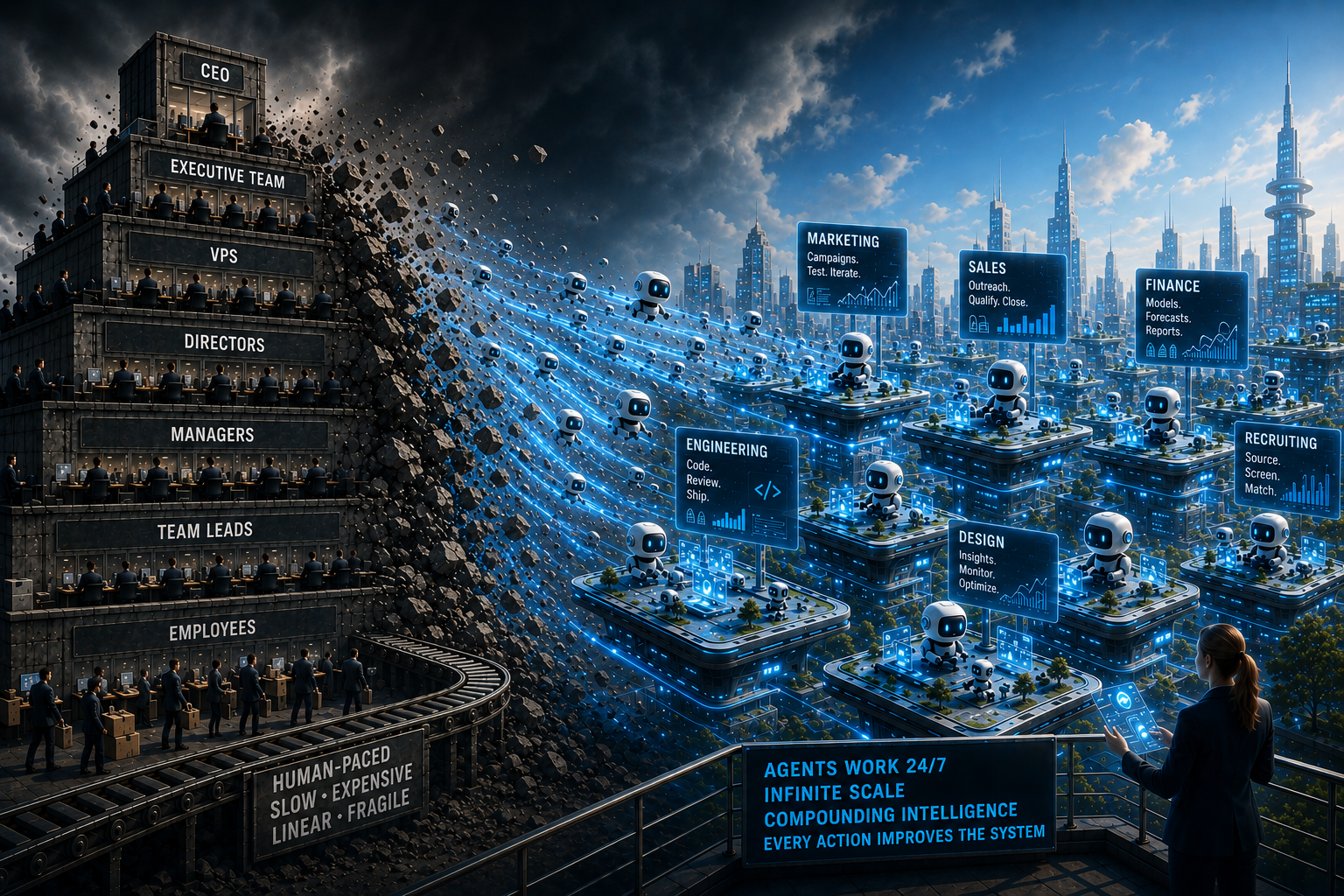
What does it mean to build a company from zero where agents are the default unit of work? Not AI as a copilot or productivity boost. A company where the org chart, workflows, software, and culture are designed around agents from day one, and humans exist only where an agent can't. The dinner with a key customer. The high-stakes negotiation. The creative bet that defines what the company even is. Everything else is a system.
Most companies adopting AI report 20-50% productivity gains. The exception is software engineering, where coding agents are well ahead and teams are seeing real exponential gains. Everywhere else, you're paying for compute, licenses, integration, and change management to get a 30% lift. Anything less than an order of magnitude is unacceptable.
The agent works at machine speed, but the workflow waits for a human to decide what matters, resolve ambiguity, and approve the ship. Intelligence is fast. The pipeline is human-paced. A jet engine on a bicycle. The frame can't take the thrust.
How did we get here?
The Roman legion solved a specific problem: how do you coordinate tens of thousands of people in chaos when the only communication channel is a human voice? The answer was a hierarchy of small units. Ten soldiers under a decanus, ten decani under a centurion, ten centurions under a tribune, up to the general. Orders cascaded down, status flowed up, no one tracked more than ten others. That structure outlived Rome by two thousand years. It became how armies operated, how the Church organized, how factories ran, and how every modern company is built. Departments, managers, directors, VPs, and an executive team are the legion with different uniforms.
AI inverts the premise. Agents don't need chains of ten. They don't lose context in handoffs. They don't need a manager to translate strategy into tasks. The bandwidth problem the legion solved is gone, and the structure built around it is no longer load-bearing. Every layer was also a layer of latency and politics.
AI only company
AI-native means the company is built around agents but humans still own the work. AI-only means agents own the work, and humans step in only where an agent can't.
The standard objection is that jobs are fuzzy bundles of judgment, context, and situational awareness agents can't replicate. True, but it cuts the other way. If a job is a human-shaped bundle of tasks, why preserve the bundle? It exists because one human had to do all of it. Agents don't. Unbundle the work and route each piece to whatever does it best.
You don't hire a marketing lead and give them AI tools. You design a marketing system where agents produce, test, and iterate, with a human reviewing direction. Sales, modeling, recruiting, analytics, design, code review. Each used to be a headcount line. Each is now a system with a human at the perimeter.
The bar for adding a human rises sharply. You don't hire to scale a function. You hire for something scarce: domain expertise, a creative voice, a network, the ability to operate in ambiguity. A 15-person company doing $50M ARR isn't a curiosity. It's the new template.
The self-improving loop
An AI-only company isn't just running on agents. It's running on agents that improve the agents. In a human company, learning is bottlenecked by people. Lessons live in heads and decay when people leave. In an AI-only company, learning compounds. The system gets better while it sleeps, and it doesn't sleep.
This requires three things from day one.
Total context capture. Everything gets recorded. Every message, conversation, email, call, decision. Ideally you mic up every employee, every conference room, every water cooler. If it happened, it's in the system, and the agents can learn from it.
Every action creates an eval. When a human corrects an agent, the correction isn't a one-off fix. The mistake, the verification, the right answer, all of it gets recorded and fed back into the improvement pipeline. Every employee is a labeler.
Software is ephemeral. Agents make code cheap. A dashboard gets spun up for a meeting and thrown away after. The one you build today is worse than tomorrow's, and tomorrow's takes minutes. Legacy enterprises spend years maintaining software they built in 2015. AI-only companies rebuild on demand and discard them entirely.
The incumbent's dilemma
The 50,000-person enterprise can't build this way. The math is staggering at their scale, but they can't fire everyone overnight without the business seizing. Institutional knowledge, customer relationships, regulatory obligations have to migrate gradually or it breaks.
So we get the slow-motion layoff. The 99% layoff stretched over years. A layoff, then another, then a hiring freeze, then a restructuring, then another. Every workstream is measured for what an agent could take over, and as soon as it can, the headcount goes.
The direction is inevitable, not because it's good for society but because it's good for business. The moment one company in a category delivers faster and cheaper by removing humans from the flow, every competitor follows. And the AI-only competitor isn't standing still. It's compounding. By the time the incumbent catches up, the AI-only company is somewhere the incumbent can't reach.
The horseless carriage problem
The biggest mistake most companies are making is treating AI as a synthetic human, a drop-in coworker for an existing role. This is the horseless carriage phase. The first cars had one horsepower because we understood new machines by what they replaced. Then engines outran the metaphor.
The point of an agent isn't to be a better employee. It's to make "employee" obsolete for most workflows. The companies that win the next decade won't ask "can a model fill this chair?" They'll ask "why does this chair exist?" and remove it.
The companies built around agents are already here. The question is whether yours is one of them.